

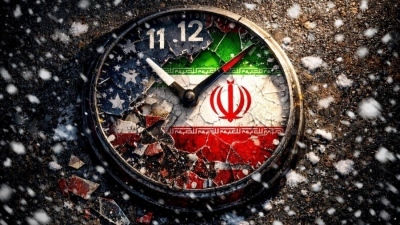
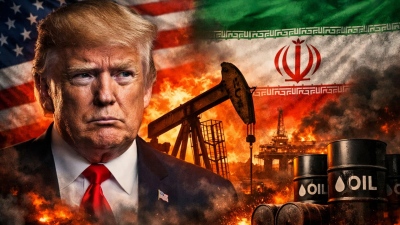
The United States is weighing four potential scenarios for the evolution of the situation in the Middle East, yet none of them appear favorable for Washington, according to The Economist magazine. In its analysis, the publication points out that the White House holds four primary courses of action amidst the fourth week of conflict in the region. These involve negotiations, troop withdrawal, continuation of the conflict, or even further escalation. However, as emphasized, none of these scenarios are considered truly "good" for the US.
Reluctant mediators
According to The Economist, achieving a ceasefire agreement seems the least likely scenario, with difficulties already appearing at the stage of selecting a mediator. Furthermore, a limited agreement, which would include sanctions relief in exchange for restrictions on Iran's nuclear program, could not fully resolve the issue. Another scenario being considered is the conclusion of the war via an announcement of the destruction of Iran's military potential. Another involves the continuation of military operations against Iran for several weeks, a scenario supported by many Israeli officials. The fourth scenario is linked to potential US attacks on Iranian power plants and a landing to seize Kharg Island. However, as noted, such a move carries grave risks and could pose an additional threat to the Persian Gulf countries.
The end of the war is far off
The analysis concludes that none of the four scenarios will actually lead to the end of the war. Previously, the US had stated that the American armed forces are frustrated with the operation against Iran.
The impact on markets
Meanwhile, according to American media, there is a massive divergence in expectations regarding the course of the conflict in Iran and its impact on the markets. The differing estimates stem from three key issues that cannot be verified or answered for the time being:
-
First, to what extent navigation can resume after the reduction in conflict intensity.
-
Second, whether the Federal Reserve prioritizes general inflationary pressure indices or actual employment conditions.
-
Third, whether China faces a cost-shock or an opportunity for supply chain order transfers. These issues may only become clear in April. Amidst this great uncertainty, the market has seen some short-term position reductions, with previous winners recording the largest drops. Generally, most opportunities based on performance or narratives have returned to the same starting point in terms of year-to-date returns. The last three months can be viewed as market rotations determined by the conflict between expectations and narratives during spring volatility and calm, rather than as defining moves of the year. The broader recovery of the PPI and price pass-through, as well as the improvement in corporate profitability, remain the fields with upside potential and expectation differences for this year, while significant decisions are expected in April.
The three main controversies
Conflict de-escalation and restoration of navigation (TACO) vs. Navigation has not returned, the energy chain has not absorbed the disruptions. The first view argues that the continuous targeted attacks by the US and Israel since February 28, 2026, have severely hit Iran's leadership, intelligence services, and military structures. According to this logic, provided there is a timely halt and rapid withdrawal, the TACO strategy will hold. The opposing view emphasizes uncertainty: until March 19, only five ships were passing through the Strait of Hormuz daily, while the price spread between Brent and Dubai/Oman remains large, indicating that full restoration of navigation has not occurred.
Increased risk of stagflation
The first scenario predicts that cost pressures will delay interest rate cuts by the Federal Reserve, while the second scenario estimates that AI investments and strong industrial demand will limit the need for strict monetary policy, as energy will not cause immediate tightening.
The supply chain
The first scenario focuses on China's high dependence on oil imports from the Middle East, while the second highlights the reduction of dependence on crude, the preparation of strategic reserves, and energy diversification, with the potential to transfer orders from other regions to China.
Uncertainties
The restoration of navigation remains limited: only five ships passed through the Strait of Hormuz on March 19, 2026, while VLCC rates have skyrocketed to historic high levels. The Federal Reserve maintained the interest rate range at 3.50%-3.75%, with a cautious tone, waiting for the effect of energy shocks on the labor market and inflation to clear.
Market strategies
The market is currently moving primarily based on narratives and liquidity. High valuations, uncertainty in profitability, and volatility pushed absolute return funds to reduce positions. Short-term corrections mostly affected stocks with previous high returns. Decisions in April–May are expected to be decisive, as the key parameters around the conflict in the Middle East, China's pricing power, and the expected profitability of industrial chains will become clear. The recommendation remains in sectors where China has a market advantage, high replacement costs abroad, and elastic supply under political influence, with emphasis on new energy, chemicals, power equipment, and non-ferrous metals. Price increases remain the "spearhead" for the market, with the next two months determining the direction.
www.bankingnews.gr






Σχόλια αναγνωστών